
What is FOGO?
Understanding Your Green Waste Bin
Banana peels, coffee grounds, lawn clippings… they all have something in common – but do you know what that is?
You may already have a green-lid bin at home. This is your FOGO bin, which stands for Food Organics and Garden Organics and it’s quietly changing the way Australians manage their household waste.
If you’ve ever wondered what actually goes in your green-lid bin or why it’s important, you’re not alone. Understanding FOGO is a simple step that can make a big difference in reducing landfill and creating valuable compost.

Image: Green (FOGO) bins lined up for collection
So, what exactly is FOGO?
FOGO is a waste collection system that separates food scraps and garden waste from general rubbish. Instead of sending these materials to landfill, they are collected in a dedicated green-lid bin and processed into compost.
In simple terms, it means your fruit peels, coffee grounds, grass clippings, and garden trimmings all get a second life rather than becoming waste.
Why FOGO matters
Food and garden waste make up a large portion of what ends up in landfill. When this organic material breaks down in landfill conditions, it produces methane, a greenhouse gas far more potent than carbon dioxide.
FOGO helps change this by keeping organic waste out of landfill and turning it into nutrient-rich compost that can be used to improve soils in parks, farms, and gardens.
It’s a small change at home, but one that adds up quickly across entire communities.
Can compostable coffee cups or other takeaway paper cups go in FOGO?
In most cases, no.
While it might seem logical that compostable coffee cups or takeaway paper cups belong in your FOGO bin, the reality is not always that simple. Acceptance of these items varies across Australia, and only a small number of councils currently allow certified compostable packaging in their FOGO systems.
In New South Wales, for example, the NSW Environment Protection Authority has directed councils not to accept compostable packaging in FOGO bins due to challenges processing these materials at composting facilities.
The challenge isn’t intention – it’s inconsistency. What’s accepted in one council may be rejected in another, which is why “compostable” doesn’t always mean it belongs in your green bin.
Because rules differ between councils, it’s important to check your local guidelines before placing any compostable cups or packaging in your green-lid bin.
Luckily, compostable coffee cups and other takeaway paper cups can still be recycled through Simply Cups, providing an alternative solution to keep them out of landfill.
Find your closest Simply Cups drop off location here.
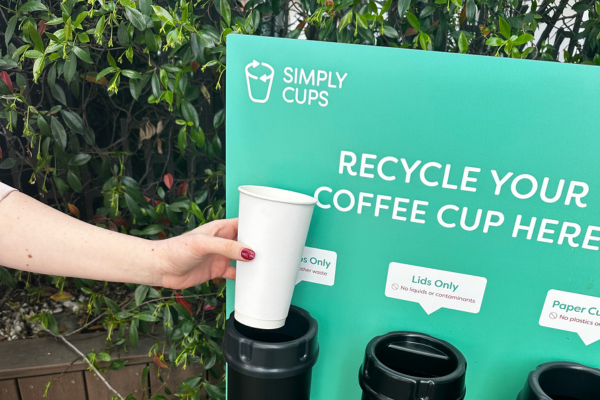
Image: Paper cup recycled with Simply Cups
What can and can’t go in your green bin
While most FOGO bins accept similar organic waste, specific rules depend on your local council. Always check your local guidelines to be sure.
What is generally accepted:
Fruit and vegetable scraps
Meat, bones, fish, and dairy
Bread and baked goods
Eggshells
Leftover food scraps
Coffee grounds and loose tea leaves
Cut flowers
Garden clippings, leaves, weeds and small branches
Paper towels and compostable food-soiled paper (where accepted)

What is generally not accepted:
Soft or hard plastic
Tea bags or coffee pods
Paper, cardboard, aluminium, steel and glass items
Nappies
General household rubbish
Pet faeces or litter
Cigarette butts
Batteries
Rocks or pebbles
Rope, twine or fabric

When in doubt, it’s always best to check your local council guidelines.
Making small changes at home
Switching to a FOGO system doesn’t require big lifestyle changes, just a few small habits. Keeping a small kitchen caddy for food scraps, separating waste correctly, and knowing what goes into each bin can all help make recycling easier and more effective.
These small actions add up, especially when adopted across households at scale.

Image: Kitchen caddy for food scraps
Upcoming FOGO regulations in NSW
In New South Wales, new regulations are set to expand the rollout of FOGO services across the state.
Households
By 1 July 2030, local councils in NSW will be required to provide all households with access to a Food Organics and Garden Organics (FOGO) bin wherever a residual (red-lid) waste service exists.
Businesses
Supermarkets, institutions, and hospitality venues in NSW will also be required to implement source-separated food organics collection. This will be introduced in stages from 1 July 2026 through to 2030, starting with the largest waste generators.
Large supermarkets
These organisations will need to track and report food donations across key categories such as meat, dairy, fruit and vegetables, frozen goods, and baked items, helping to improve transparency and reduce food waste across the supply chain.
This shift also highlights the growing need for on-site solutions, such as Closed Loop’s commercial composters, which help businesses manage food waste directly at the source. By reducing reliance on collection services and turning organic waste into valuable compost on-site, organisations can stay ahead of regulations while improving their environmental impact.

Image: Kitchen caddy for food scraps
The bigger picture
FOGO is part of a wider shift towards a circular economy, where resources are reused and repurposed rather than discarded.
But like any system, it only works when it’s used correctly. At home, that means understanding what goes in each bin. At a larger scale, it means designing systems that can handle real-world behaviour – not perfect behaviour.
At Simply Cups, we see the same principle in action every day through cup recycling. Whether it’s food waste or takeaway cups, the goal is the same: keep valuable materials in use and out of landfill.
FOGO might seem like a small change, but its impact is significant. Using it well is what turns good intentions into real outcomes.
Resources:


